.png)
How to Get Natural On-Camera Performances From Executives and Staff Who Hate Being Filmed


The single most common reason a corporate video underperforms is not the camera, the lighting or the edit. It is a nervous person on screen who does not sound like themselves. After 18 years filming executives, engineers, nurses, tradespeople and customers across Sydney, we can tell you that on-camera confidence is a production problem, not a personality problem. It is fixable, and most of the fix happens before anyone presses record.
Here is how we approach it, and what you can do as the marketing manager holding the brief.
Why do people freeze on camera?
People freeze because they are being asked to perform rather than to explain. Most staff have never been filmed professionally. They walk into a room with lights, a crew, a big lens and someone from head office watching, and their brain switches from "explain my job" to "do not embarrass myself in front of the company." That switch is what makes speech stiff, eyes dart and answers turn into corporate word salad.
The practical implication: anything that reduces the sense of performance improves the footage. Smaller crew, fewer observers, a conversation instead of a script.
Should you script your talent or let them speak naturally?
For anyone who is not a professional presenter, use a message map rather than a full script. A message map is three or four points you need them to land, in their own words, with an agreed opening line. Full scripts force non-actors into recall mode, and recall mode looks exactly like lying on camera: flat delivery, eyes up and to the left, unnatural pauses.
Scripts still make sense for presenter-led explainer videos, television commercials and voiceover-driven brand video, where a professional performer or a voice artist carries the words. For case study videos, testimonial videos and internal or HR content, unscripted interview almost always outperforms.
What should you send talent before the shoot?
Send the themes, not the exact questions, at least three days before the shoot. We recommend a short one-page brief covering:
The three or four topics they will be asked about
Roughly how long the interview will take (usually 30 to 45 minutes for two to three minutes of final footage)
Where the video will be used, and who will approve it
What to wear: solid mid-tone colours, no fine stripes or busy patterns, no logos other than your own
A clear statement that mistakes are normal and get edited out
That last line does more work than anything else on the list. Most nerves come from the fear that a stumble is permanent. It is not. In a typical corporate video interview we will use maybe eight percent of what a person says.
Sending the exact questions word for word tends to backfire. People memorise answers, then deliver them from memory rather than thinking on camera.

How do you set up a room so people relax?
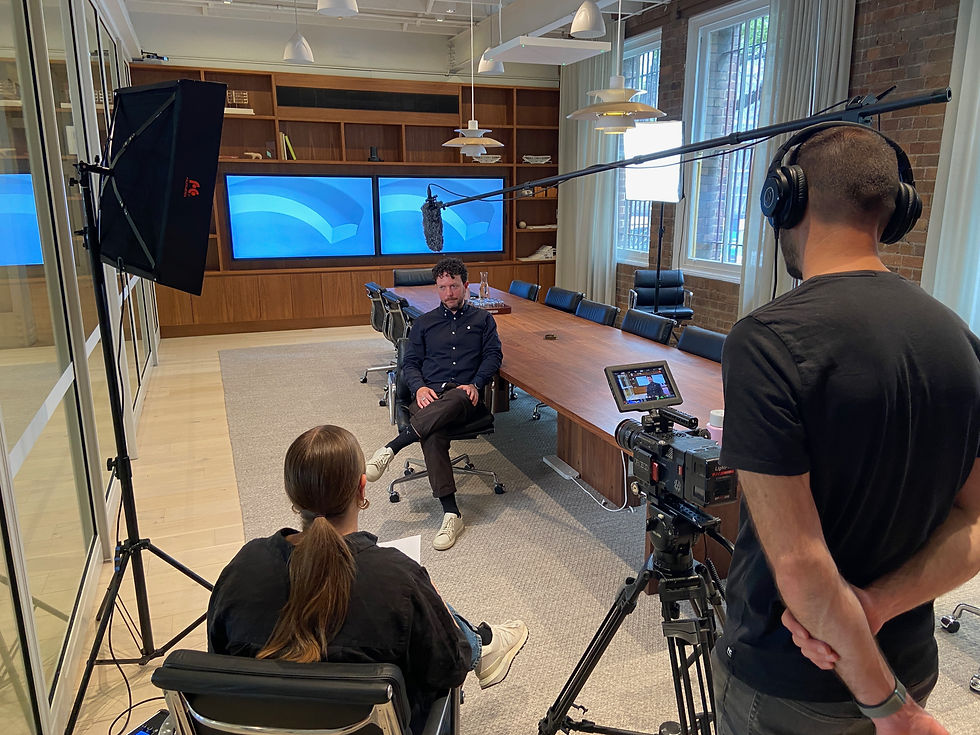
Keep the crew small, remove the audience and put the interviewer beside the lens. Our standard interview setup for camera-shy talent is two crew, soft lighting rather than hard key light, a comfortable chair at the right height and the interviewer sitting as close to the camera as physically possible so the subject is looking almost down the barrel while making eye contact with a human.
A few other things that measurably help:
Roll early. We start recording during the small talk. The best grab is often the answer they give before they think the interview has started.
No senior observers in the room. A CEO watching a team leader speak changes what that team leader says. If a stakeholder must be present, put them on a monitor in another room.
Book a buffer. Executives run late and arrive stressed. Ten minutes of coffee and conversation before the first question is not wasted time, it is the cheapest performance coaching available.
Do a throwaway first question. "Tell me what you had for breakfast" burns off the worst of the nerves on footage nobody will use.
What do you do when someone is still not landing it?
Change the question, not the person. If an answer is stiff, the usual cause is that the question invited a corporate answer. Ask them to explain it to a specific person instead: "How would you describe this to a new starter?" or "What do customers get wrong about this?" Specific, human framing produces specific, human answers.
Two other techniques we use constantly:
1. Ask the same question three different ways across the interview. The third version is nearly always the most relaxed.
2. Ask them to answer in full sentences without repeating the question, then feed the same answer back to them: "So the short version is X?" People agree and then say it better.
If someone genuinely cannot get there, we have options that do not involve forcing it. Voiceover over observational footage, 2D or 3D animation, a photography-led piece with text, or building the story around a different spokesperson. Nobody should be shamed onto a screen. There is always another way to tell the story.

How much does prepping talent cost?
Prep costs almost nothing and saves real money. A 20 minute pre-shoot call with each interviewee typically adds under an hour of production time, and routinely saves half a day of shooting plus the reshoot risk. Reshoots are the expensive failure mode: crew, location, travel and the executive's calendar all again, usually for a five figure sum on an enterprise production.
Put another way, the cheapest edit is the one where you had good answers to choose from.
Who should actually be on camera?
Put the person closest to the work in front of the lens, not the most senior person available. Enterprise brands default to the executive because of hierarchy, but audiences respond to specificity. A project lead who can describe exactly what happened on a job is more convincing than a general manager describing strategy in abstractions.
A useful split for a case study video: the executive frames the why in 20 seconds, the practitioner carries the how for 90 seconds, and the customer provides the proof. That structure also protects your production schedule, because you are not dependent on a single busy diary.
Bottom Line
Camera-shy staff are normal, and nervous footage is a preventable production failure, not bad luck. Brief your talent on themes rather than exact questions, keep the crew and audience small, seat the interviewer next to the lens, roll early, and choose the person closest to the work rather than the person highest on the org chart. Do that and you will get usable, human footage from people who told you they hate being filmed.

Global Pictures is a Sydney video production company with more than 18 years of experience producing brand video, case study videos, testimonial videos, explainer videos, corporate video, animation and photography for enterprise clients. If you have a story worth telling and a spokesperson who is dreading it, that is a very ordinary day for us. Get in touch and we will walk you through it.


Comments